Category Archives: Uncategorized

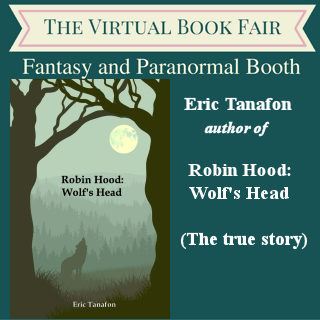
Virtual Book Fair Booth–Robin Hood: Wolf’s Head by Eric Tanafon

I’m participating in The Virtual Book Fair! The event is live November 12-21. For more information, check out the event on Facebook here.

book_fair_booth

I’m Eric Tanafon. Thanks for visiting! I’m an eccentric, reclusive author with a large family, living in genteel poverty in New England.

Robin Hood: Wolf’s Head reveals, for the first time, the true nature of Robin’s band of merry….men?

Be warned, for Here There Be…

Creatures of darkness, not all alike. Kings without crowns, knights who left their shining armor behind. Witches, hermits, berserkers, and other honest outlaws. Ballads sung to the lute and spells spoken by moonlight.

Stories within stories, a Thousand and One Sherwoodian Nights.

And in the end…redemption.

***************************************************

Right now, you can get a copy for only 1.99. Why not preview it first?

Scavenger Hunt Number: 10

Find more booths to visit here!

Stacking Wood

I and my family observe a special holiday each fall: Wood Stacking Day. I admit it’s a bit eccentric, but this is New England, so we’re allowed.

We celebrate it by spending pretty much all day lugging logs from our driveway to stack on the porch, or down cellar once the porch is full. Like most celebrations, this tends to cause a hangover. In this case it’s sore muscles, rather than an aching head.

Hauling logs from one place to another gives me a lot of time to think. Naturally, it occurred to me that this activity amounts to a metaphor for writing.

You start with a disorganized pile of logs. These represent all your story ideas. At first the task seems overwhelming, but you select some logs, a few at a time, the ones that seem like they’ll fit together. Gradually a structure begins to reveal itself–first an outline, then, if you’re lucky, an actual plot emerges.

You build up the layers of wood higher and higher, complication on complication. At last you place the last few logs and you’re done. The resolution has been reached and now you’ll begin to go through the stack, building fires to keep yourself warm on the cold nights that are coming. Since the wood burns faster than it grows, I’m going to say this is analogous to reading the finished story–years of work consumed in a few days or weeks.

What’s left? A smaller pile of chips too small for kindling, loose pieces of bark, and dirt. We use this as mulch for our hedge. I guess it would correspond to unused ideas, or bits of them, things that didn’t quite work out. So you recycle them, returning them to your subconscious to help nurture your stories yet unborn.

Happy Wood Stacking Day, all!

A Bridge that Never Was

Bridge of Birds is a triumph, a huge, picaresque magical journey through a China that ‘never was’, but in some ways, will always be. I found this book initially because I had read Ernest Bramah’s Kai Lung books, and wished there were more of them. Bridge of Birds is not much like Kai Lung, really, other than the Chinese fantasy setting–the characters don’t speak formally, which is where much of the humor in Kai Lung comes in, and the story-within-a-story structure is absent–but the story is vastly enjoyable in its own right.

One of Hugharts’s triumphs is, paradoxically enough, making his characters universal: his magical China contains vulgar peasants, beautiful maidens, supernaturally gifted con men, matriarchs both good and evil, gods and goddesses who interfere in the mortal realm, misers with hearts of gold, and tyrants with no hearts at all. In other words, it’s like the fantastic world of any traditional culture from Europe to Japan. Also, this book has some of the most affecting and simply human passages I have ever read–for example, Miser Shen’s lament for his daughter.

Even given the large cast of characters, Li Kao and his protege, Number Ten Ox, carry the story as easily as Ox carries the old sage on his shoulders. They are wonderful characters and fully deserve the ultimate fate that the author had planned for them: to be accepted into the heavenly realm to live forever as minor deities.

For me, the other two books in this series, though still enjoyable, are a bit of a letdown. (spoiler alert) For one thing, they use the same basic plot outline as Bridge of Birds, though with varied characters and a different Chinese ritual as background. Also, the occasional bawdiness of the first book spins out of control, for my taste, particularly in The Story of the Stone.

But Bridge of Birds is a masterpiece–among the best modern fantasy books I’ve ever read and re-read.

Self Publishing: The Road So Far

It’s been a year and change since I started my self-publishing career. In the course of getting my two books (so far–another is planned for November) into print, I’ve learned a few things. Strangely enough, they all have something to do with giving.

You must give in order to receive.
Reviews, that is. Trying to get book bloggers to review your work feels uncomfortably like sending query after fruitless query to literary agents. No small part of my motivation in self-publishing was to see such things only in the rear view mirror (like Lubbock, Texas) and thus find happiness. But it’s true that otherwise, nobody gives you a review unless you invest some time and write one first.

Well, not completely true–I have gotten exactly one unsolicited review between my two books. It was only 3 stars, but hey–that means there is at least one casual reader out there who thinks my work is not completely worthless, and what’s more, is willing to say so.

Also, on the plus side, reviewing has introduced me to some great authors whose works I intend to keep following.

Sometimes you can give it away, but should you?
I’m seriously considering not doing any more Goodreads giveaways–the one I did this year attracted quite a few entries, but garnered zero reviews and even zero ratings from the readers who wound up with copies. It did result in a couple of copies showing up for sale used, which makes me feel like I’ve arrived, in a sense. But the real payoff is that, without a giveaway, I don’t even need to put the time into preparing a print edition. 95% of my sales have been e-books, anyway.

Don’t give up.
In accordance with the soon-to-be-infamous Rule #4 in my upcoming book, Father Winter, there are no guarantees. So, chances are that fame and fortune will take their own sweet time to materialize. After all, they have eternity. And there will inevitably be a lot more of those times when discouragement sets in, and I feel like taking my marbles and going home.

Unfortunately for me, I’ve already lost all my marbles. And this is home.

Phases of the Moonstone

I think it’s no accident that in Wilkie Collins’ The Moonstone, there’s more than a suggestion of lunacy. Characters go mad with love or opium, or cultivate obsessions ranging from roses to evangelical tracts and Robinson Crusoe. And not all of them can offer the stone’s curse as an excuse.

Many readers have commented on the number of ‘firsts’ that the Moonstone represents for a mystery novel. I’ll offer a couple more that I didn’t see mentioned: first story in which a great detective initially fails to solve the case, then gets another shot and makes it count; and first story to use a device that’s brilliant in context, but can never be used again because it’s so unlikely and would immediately make any reader think, ‘The author is just copying The Moonstone.’

The journey, with its multiple narrators, is varied and satisfying. The nineteenth-century pacing means that it takes longer than you might have expected, and you wind up lingering in a few country lanes or village pubs while you wait for fresh horses, but that’s far from a bad thing. And then, of course, there’s the happy ending. Characters you like are rewarded (or possibly go to their graves still concealing terrible secrets that have ruined their lives, but hey, it’s Victorian times, so you have to expect a bit of that). Best of all, the Moonstone is returned to where it should have been centuries ago: the temple of the moon god, whose devotees include, whether they know it or not, most of the characters in this book.

Blueberries Enough, and Time

“Look! Blue apples in the trees!”

Peter in Blueberry Land
(Elsa Beskow)

Today I went out with my wife, son and daughter to pick high-bush blueberries. We have five bushes, and they’re bearing well this year, which means that some days in July we need all hands on deck. We head out with our containers and go along the row, reaching up and down, pulling branches back, sometimes merging with the bush to find the berries hiding in its depths. Blueberries become, for us, an element in themselves–deep blue like the sky swelling with rain just before a storm breaks, or gleaming even more darkly, like black pearls. “Annihilating all that’s made / To a blue thought in a green shade” (with apologies to Andrew Marvell–again).

We’re not alone, of course. Ants crash this party as they do any other. One of our cats wanders over to see what we’re doing, losing interest when it concludes that what’s happening is actually some form of work. The resident mockingbirds, perching a couple of bushes down from where we’re picking,  keep an eye on us and give their alarm call now and then. They started feeling uneasy about me when I trimmed the hedge where they have their nest, and now their darkest suspicions have been confirmed. We leave some blueberries for them as a peace offering.

When I close my eyes at night, I still see blueberries, hiding behind and under leaves in the sun and shadow. I’m holding a handful already, but wherever I look, there are always more. I reach through the bush to where I’ve just glimpsed the best one yet, round and ripe, dusky twilight blue, finding it more by touch than sight.

Sometimes I miss, and wind up picking a berry that’s still small and green, and now will never ripen. But more often than not, it’s perfect.