Category Archives: Uncategorized

The Blackthorn Legacy

First, I should mention that my books are on sale again for 99 cents on Amazon until next Wednesday, in case any visitor has unaccountably neglected to collect my oeuvre to date.

Next, a little digression about what I’m working on currently. It’s called The Blackthorn Legacy and is the first of four books I’ve planned in the series, which could easily wind up being called The Blackthorn Chronicles. It’s a bit of a departure for me–it presents as, loosely, a supernatural cozy murder mystery, but ultimately identifies as something more and deeper…hopefully. I’ll offer a couple of preliminary excerpts here. It’s very much a work in progress so these may or may not find their way into the finished story in this form or any other.

First, a little background. The Blackthorn family are refugees from the West Coast who wind up in New England when their crazy uncle dies suddenly and they inherit his house and lands. It develops that he has in fact been murdered, while apparently performing some kind of magic ritual. In the first sequence we join Brian and Sylvie Blackthorn, and their children Very and Dylan, attempting to find their way to Uncle Malcolm’s house:

There was still light in the sky, but darkness was welling up from the ground below, and shadows had already claimed the woods on both sides of the road. Brian drove slowly so as not to miss any of the clues that Mr. Blood had laid out for them, like a lawerly trail of very dry little breadcrumbs.

“GPS won’t do you much good out there,” he’d told them, before giving them a series of landmarks to look for. “I haven’t been there myself, you understand. The late Mr. Blackthorn always came to our office for his business. Sally Higgins gave me these directions—you may have noticed her real estate office on the corner. If you decide to sell, you can’t do better than go to her.”

“After a year, you mean,” Brian reminded the lawyer.

“Of course. After a year.”

They jolted over a stray frost heave, and Sylvie’s teeth came together with a snap. “Ow,” she remarked.

“So, what’s next?” Brian asked, slowing down again and peering ahead. Since Sylvie was navigating, she’d taken the notes.

“Let’s see. We passed Johnnycake Lane.”

“That was way back,” Very said.

“And Back Mountain Road, and Gallows Hill Road, and Old New Providence Road.”

“I liked Old New Providence,” Brian said.

“Gallows Hill was my favorite,” Very said. “That must be where they hung the highwaymen. And the witches.”

“And,” Sylvie went on, “we went past the place where the dead tree overhangs the road.”

Dylan remembered that vividly. The tree had seemed still alive, to him. Probably it was just pretending to be dead, for reasons of its own. But it didn’t hide a face in the rough folds of its bark, like many of the other trees they’d passeds. It reached out over the road hungrily, but blindly, and he was glad it didn’t seem to be able to see them.

“Check.” Brian nodded.

“And we haven’t come to…let’s see…’the break in the woods where lightning started that fire last year and burned down a lot of the older trees’. Which is good, because that would have meant we’ve gone too far.”

“Okay…”

“And we also haven’t seen any ‘Class Six Unmaintained Road’ signs, which we would have if we’d missed that place where we needed to bear left, ‘which is easy to do unless you keep a sharp eye, and if you forget and go straight, the road will take you right up the mountain, and you won’t be able to turn around for half a mile or so’,” Sylvie quoted. “Wow, Sally must be a good real estate agent. Very detail oriented.”

“What mountain?”

“The mountain, is all it says here. We’ll have to find out what its name actually is.”

“Okay…so what should we be looking for?”

Sylvie folded up the piece of notepaper. “That’s actually all the landmarks. Now we’re looking for Hill Road, which she just says is ‘a ways further on.’ It will be a right turn.”

******************************************************************

The second sequence is when the family is settling down to sleep on the day they learn that Uncle Malcolm has in fact been murdered:

The silence seemed even deeper tonight, a well of still darkness. Cocooned in his bed, eyes already closed, Dylan imagined himself looking up at the autumn stars. They were cold and bright and far away. The only sounds he heard, now and then, were creaks and faint groans, the house talking softly to itself as it settled into its own time of dreams.

He thought of Charlotte, who had smiled at him a couple of times, and then of Sheriff Greenlaw. He’d liked the sheriff, whose face was friendly after he’d taken off his sunglasses and you could see his windows (of the soul, his father had said that once a long time ago, and anyway windows were eyes too, wind-eyes, that’s what his mom had told him).

Dylan fell asleep still wondering why so many people did that, hiding their eyes, hiding their faces behind masks. Did they get tired of seeing things? Or were they just afraid of being seen? He felt he was getting close to the answer…in two more of his slowing heartbeats, he’d have it…or at most, three…

What Very saw through her closed eyes was the moon—such a moon as she’d never seen rise, huge and orange, even though outside, in the night, it was a new moon and Dylan’s stars held the sky. And she and Charlotte were flying together—not clutching broomsticks, not riding dragons or griffins or flying horses, but just flying. It seemed to Very that she’d always had the knack, but kept forgetting about it until something happened to jog her memory.

She and Charlotte rode the wind, swooping down to touch the trees, then spiralling up toward the moon, which seemed out of reach, but only just. And then with Charlotte flying ahead, looking back over her shoulder to make sure she was following, Very felt the winds fail and the air, suddenly still, caught and held her. She almost opened her eyes with the surprise of it, but instead of falling she began drifting down, like a leaf, rocking gently back and forth.

When the bough breaks, she heard her mother’s voice singing, but she thought sleepily the bough doesn’t break, the leaf just lets go. And she did.

Sylvie had more trouble getting to sleep. She couldn’t stop thinking about Uncle Malcolm dying just upstairs. If it had been their bedroom, she would never have agreed to sleep there. But Brian (and it was his uncle, she reminded herself) hadn’t seemed to be bothered by it, and Sylvie didn’t want to make a fuss about mere proximity to death. Every old house has seen people die.

It reminded her of a time she was driving, and when the traffic slowed, found herself stuck behind a truck for a company that made coffins. A bad omen, maybe, if the truck had been following her (there was an old folk belief about that, she remembered), but as it was, just a funny anecdote.

And besides, she thought, that room wasn’t really so close. It was far, far above them…wasn’t it? Yes. The tower, in her mind, had risen into the sky. And something about that high room was drawing her. She opened the door, she walked up the spiraling stairs that seemed endless as the night. But she came at last into the room with its high windows.

She hardly remembered Uncle Malcolm’s death now. It was the stars that mattered, the high, cold stars…she could begin to see patterns in them, they formed a picture, filling the sky with some huge meaning she could just begin, now, to grasp…

Brian fell asleep quickly, but it was the kind of sleep that comes over you like a trance, and feels like being paralyzed. He knew he was asleep, but he felt himself locked in his own body. Within him his spirit stirred, and stretched, and shifted from side to side, testing the limits of this self-prison.

But he didn’t struggle enough, quite, to wake himself up. Still, in a short while, there was a blur of confused images and then he found himself out.

He was standing in front of the door to the tower stairway. There was a faint light from somewhere. It took him a moment to realize it was coming from the crack underneath the door.

Of course, he thought, his uncle must be up there. Working late, as he often did. In fact now Brian could definitely smell the smoke from Uncle Malcolm’s pipe. He remembered now that his uncle was always smoking that pipe, and as a child he’d loved the aromatic scent.

He heard the sound of the knob being turned, and the door began to swing open.

Brian jolted back into his body as if shot out of a cannon. He sat bolt upright in bed, his heart pounding. Sylvie was sleeping deeply next to him. The house was completely still, holding its breath.

But even though he was wide awake with sleep now hours away, he could still smell the scent of his uncle’s tobacco, hanging heavily in the air.
Sean’s Saga: The Last Battle

Here’s another excerpt, this time from the last book in Sean’s series (barring unexpected things such as the world not ending after all). In this scene, with Fimbulwinter freezing Puget Sound solid, Sean decides to once more consult his occasionally prophetic laptop about what’s in store for him and his friends when Ragnarok comes.

******************************************************************

I hadn’t touched my old laptop in a while, but for some reason tonight I felt like taking a look. I could even have made a case for playing some Twilight of the Gods (TOTG), something like Maybe I missed some random clue Loki embedded in the game, that will make all the difference! But it didn’t matter anyway, since electronic devices don’t work on Runnymede.

Don’t work normally, that is. But my laptop has been known to open a window on the future (or the past, or different places in the present, or maybe alternate timelines. Basically the same standard disclaimer Galadriel pulled out when Frodo took a look in her mirror.)

I know, what did I think I was going to see, with Ragnarok about to hit us like a million tons of jotuns, trolls, and assorted monsters?

Anyway, what I did see was boring, at first. It was just an empty plain, stretching out as far as I could see. It wasn’t day, or really night either—more like one of those twilight places I’d seen way too much of in the last while. I thought for a second it actually might be Hel, but there was no river and no city. Just the empty land.

Then the first jotuns came into view. Mountain giants and frost giants, mostly, but there were puffs of smoke drifting around that made me think fire giants weren’t far behind. It was an army of them, more than I’d ever seen at one time, or actually all the times I’ve seen them put together. They seemed bigger than usual, even for giants, but it was hard to tell with nothing else in sight.

Then some trolls started showing up around the edges, and I could tell just how big they were. They were big. These guys had definitely eaten their meat and potatoes and cleaned their plates, like their giant moms told them to.

They kept on coming in endless waves, passing the point where my magic camera was, I guess, floating in the air. Yup, there were the fire giants, hundreds of them, but who’s counting? I remembered how tough it was dealing with one fire giant in Asgard, and lost track of my stomach for a second.

Other things started to show up after the fire giants had passed by. Dragons, most of them fifty-footers or more, if I was any judge. Hey, where had they found so many? When we wanted a new treasure guardian for Runnymede, we’d had to go on a quest to find one. Maybe there were dragon farms somewhere, run by jotuns in asbestos overalls, with giant kids coming to feed and pet the baby ones.

There were two kinds—green dragons, like the one I’d more or less accidentally slain in the first book, that breathed fire as they slithered along, sometimes incinerating a troll or two (now I really understood what my dad and Fiona were talking about when they mentioned ‘friendly fire’), but also white ones. Those just darted out their tongues once in a while, so I assumed they didn’t breathe flame. No clue what they might do instead, except I was pretty sure I wouldn’t like it.

Then I started seeing the draugr. At first I thought those flickers I saw on the screen were caused by, I don’t know, bad prophecy transmission conditions. But then one paused and, as far as I could tell, looked right back out of the screen at me. It looked human, mostly, and wore armor that looked pretty normal, thought maybe a bit rusty. But the face was kind of falling apart, and the eyes were more like black holes.

Once I saw the first one, they were everywhere. Way too many to count, like the trolls and jotuns. (All right, I could probably have counted the dragons, but I didn’t.)

There were other things, too—swords and maces and spears just cruising around like berserk drones, things like animated trees stumping around—literally, they were actual stumps with branchy arms, and you know how when you look at a tree, you can see faces in the bark? You couldn’t not see these. Not to mention the wargs—lots of the trolls were mounted, most using serpent-reins, like the one that had crashed through our picture window what felt like ten years ago.

It seemed like way enough, and I kept expecting the viewpoint to shift and maybe show me something useful. But they just kept on coming. If they didn’t have twenty monsters to every hero I could even imagine getting to the battle, it wasn’t the fault of the hard-working Muspelheim and Niflheim recruiters.

“Where are they coming from?” I wondered aloud.

The laptop seemed to hear that, and finally the scene changed. I had trouble making out exactly what was going on, at first. There was a lot of motion on the screen, but it was like shadows just going around in circles. Then the picture sharpened and I saw two giants—giant women, actually, not that they were any less burly or scary than the guys—who were pushing a huge wooden shaft around, which went through an equally huge, circular stone.

And now I was getting audio, too—a grinding noise that sounded like a waterfall full of swords and armor going off a high cliff, but actually came from the millstone going around and around.

The work wasn’t making the women break too much of a sweat, I guess, because now I heard that they were talking at the same time (in verse, like so many of my least favorite people were lately):

Grind, mill, grind,

Grind out horrors

And the death of heroes!

Grind draugr and dragon,

Warg and woodwose,

Nightmare and maelstrom!

Grind, mill, grind!

They kept repeating that over and over, in singsong voices that I had no trouble hearing over the white noise overload of the grinding. And meanwhile, what looked like shadows, but I was totally willing to believe would become all the evil things they were name-dropping, were streaming out from the mill­stone in all directions.

Thanks to Lore class, I knew what I was looking at, which was a good thing since I didn’t have Parvati around to ask at the moment. The magic millstone was called Grotti, and it could grind out whatever you wanted, as long as the giant sisters could keep it turning. A king whose name I forget had the mill grind out peace and gold for his kingdom, but he wouldn’t give the sisters a break, so they ground out total doom for him.

It looked like they were still at it.

After a while, I felt my head going round and round with the grinding and the chant, like I was tied to the millstone. “That’s enough!” I said.

The laptop screen went dark. I felt a chill at the back of my neck. It had never responded to voice commands before. That, and the audio capability, seemed like somebody had pushed out an upgrade without me knowing it. I didn’t like to think of who it might be, or why.

In fact, I just didn’t want to think any more. Not until the morning, anyway. I knew where and when Fiona was, now. With any luck, by the end of tomorrow I’d actually have a plan.

Resisting the impulse to go out and throw the laptop in the Bay, and hope that the maelstrom the giants were chanting about took it down to the bottom forever, I turned out the lights and got into bed.

Sean’s Saga: The Well of Time

Here’s an excerpt from the second, or middle, book of Sean’s Saga. To finish off this year and get a start on the next, I’ll follow with an excerpt from book 3. Hopefully those will be available in their entirety soon, they’re both finished except for some typo fixes (you never catch them all) and wording changes. Last, I plan to post a sample of the story (working title: The Blackthorn Legacy) that I’m writing now.

In this scene, Sean, Fiona, Parvati and Arturo have gone back in time to try to head off an alternate reality created by a traitor Bard who stole the magic mead of the gods. The giants have stolen Thor’s hammer, but in this timeline, with Loki imprisoned, they’ve managed to hold onto it. This bit is from the chapter titled We Crash the World’s Most Evil Wedding Party.

***********************************************************************

There was a lot of noise coming from inside, yelling and laughter and the sound of things breaking. Either there was a battle going on inside, or the jotuns were having a party.

About the time I was wondering if they ever would, the giants at the door finally noticed us. I guess they were the bouncers, because the one on the left, who looked a little less bright, boomed at us, “Show your invitations! Nobody allowed in without an invitation!”

“An invitation to what?” Parvati asked.

“The wedding feast of Thrym and Freya, of course,” the left-hand giant said, looking at us like we had two heads—or maybe more like ten, because for a giant to have more than one isn’t actually that strange.

The right-hand giant cuffed the left-hand one’s single head. “Idiot! The invitations got eaten, remember? Somebody let the cat get to them. That’s why we have this list.”

He had a scroll under one arm. He held it up and let it unroll. It hit the floor with a meaty sounding smack.

“Wow,” I said, “a pretty long list.”

“Are those all the people who’re invited?” Fiona wanted to know.

The second giant shook his head. “These are the ones who aren’t invited. It’s easier that way. Then we know that if your name is on the list, we should kill you.”

I guessed that probably made sense, to jotuns. He looked us up and down and then switched to the list. “Let’s see…none of you are Beowulf, are you?”

We shook our heads. “Svipdag? No? Sigurd? No…hey, what about Thor?”

Okay, so the second giant didn’t have much on the ball, either. It struck me that checking every name on the list would take quite a while.

“Why don’t we just save time and tell you who we are?” I suggested.

The first giant gaped at us. “Hey, that’s smart! Isn’t that smart, Headsmasher?”

Headsmasher frowned. “Could work, Leg­breaker. Could work. All right, what are your names then?”

“Arturo, son of Rodrigo!” Arturo said proudly, beating the rest of us to the punch.

Fiona elbowed him—not something I would ever try—and shot me an Are-you-nuts? look. “We’re going to tell them our real names?” she hissed. “What if there are smarter ones inside? Who know magic?”

“Relax,” I told her. “Remember, we don’t even exist in this world. There’s no way we’re on that list. And these two will forget about us as soon as we’re inside.”

She gave me a grudging nod. Meanwhile the giant had been scanning his list, getting it all tangled up in the process. “All right, seems like you’re not on here anyway,” he told Arturo. “What about the rest of you?”

“Parvati daughter of Abhay!” Parvati’s voice was firm, though I saw her give just the tiniest little shudder.

“Fiona daughter of Brian!”

“Sean son of Brian!”

Both the giants were now scrolling through the list (not bad, huh?) and grumbling. Legbreaker muttered something about “could have put it in order”, and Headsmasher said something I didn’t catch, but it sounded like “index”. At last they rolled up the scroll, sort of—it looked like the cat who ate all the invitations had been playing with it—Legbreaker heaved open the door, and they waved us in.

We walked into a thick fog of smoke and the smell of mead, and the noise was outrageous. Still, as the door swung shut behind us, I heard one of the giant bouncers—Legbreaker, I think—asking the other one, “Wait, weren’t we supposed to kill any Midgardians that showed up?”

Wow, I thought, that was close. They didn’t follow us in, though. Still, we all felt like keeping a low profile for the moment, so we sidled into the nearest quiet corner and took a minute to just look around.

Well, it was a jotun party, so what would you expect? Giants slamming into each other—dancing, maybe?—and skidding around in pools of spilled mead? Check. Burly thurses arm-wrestling while others stood around roaring with laughter? Check. A table full of enormous etins yelling out toast after toast in their rocky, grinding language, then hurling their mugs at each other’s foreheads, leaving the table covered with broken shards (of mugs, not giant heads)? Oh yeah.

“I don’t see Freya,” Arturo said after peering around.

“She wouldn’t be caught dead here,” Fiona said, with feeling.

“That checks with what Odin and Thor told us,” Parvati pointed out.

“Yeah,” I said. “It was only a little while ago we saw them, and they said Freya umm…hadn’t gone along with the idea. But then why are these guys celebrating already? Seems like jumping the gun.”

Just then, something that looked like the so-far-missing-in-action sabertooth bounded at us, tail held high, and we heard a thunderous—meow?

“So that’s the gatita that ate the invitations?” Arturo said, a few hairs sprouting from his face.

“I totally believe it,” I said, not daring to take my eyes off the giant orange cat—big as a horse—as it sniffed at us with a baleful green light in its eyes, looking like it was wondering if we were some new kind of super-sized mice, and if so, what had happened to our tails.

It had just lifted a tentative paw to bat at us when a pair of giant hands picked it up and threw it across the room, leaving a Doppler-effect yowl in its wake. “Fluffy!” the jotun who had, sort of, saved us, called after it. “Mind your manners! No eating the guests!”

Then the jotun leaned down and stretched out his hand. “Welcome! I am Thrym. Welcome to my wedding feast!”

I guess we were supposed to shake his hand, but only Arturo reached out his hand to grasp the giant’s. Thrym was shaking his fingers as he drew his hand back, and frowned thoughtfully for a second. One of the smarter giants, I noted.

“Didn’t think any heroes or Valkyries would show up here,” he said, then brightened up. “But after all, now that I have Thor’s hammer, I will be ruler of both Midgard and Jotunheim. So you’re just the first to offer me your homage. Smart move, I must say.”

I heard a growl close by, but when I turned to Arturo, I realized that it had come from Fiona. “Cool it,” I whispered. “We want to keep him in a good mood.”

“So he won’t know what hit him,” Arturo added.

Fiona didn’t look happy, but she nodded and squeezed his hand.

“—and a drink to seal our friendship,” Thrym was saying.

That’s how we found ourselves ambling over to the jotuns’ high table to bend an elbow with the enemies of mankind. Did I mention it’s a major gaffe to turn down an offer of hospitality?

On the way, we had to keep an eye out to avoid getting knocked over, or fallen on, by any of the giants who were reeling around. Even the mead spills were a bit of a hazard—they were ankle-deep to us and made the floor really slippery. Also Fluffy came back over and started to stalk alongside of us, his tail lashing.

“Nice cat,” Parvati said nervously.

“He won’t bother you anymore,” Thrym told her. “He’s a good cat, really. Excellent mouser. Got him from my cousin, Utgard-Loki.”

“Oh. So he’s the cat that Thor couldn’t lift off the floor?” I eyed Fluffy dubiously. He could have finished me off in a few mouthfuls, for sure, but he didn’t look tough enough to stymy Thor.

Thrym chuckled. “Good for you, you know your jotun history—thurstory, we like to call it. Yes, Utgard-Loki told me something about Fluffy getting quantum entangled with the Midgard Serpent, temporarily. Just a freak accident. He’s fine now.”

Well, that sure took a load off our minds. Meanwhile we’d finally made it to the table—it felt like we’d walked half a mile or so. The other jotuns who’d been there had gone off to dance, or beat each other up, or whatever it was that they were doing, so it was just us and Thrym.

Thoughts on Black Friday

It sounds downbeat. I’m old enough to remember when the first thing people thought of when they heard ‘Black Friday’ was the stock market crash. But at some point in the waning years of last century it morphed into a retail holiday (strange term–are other holidays mostly wholesale?) So, still the association with markets and commerce, but now it’s happy–or at least frenetic, as we realize how much Yuletide shopping is still to do (more about that later).

Outside here, in the country, it’s Black Friday in a different sense. The days are dark, and the few weeds left standing are black skeletons. Endless waves of leaves, skeletal too from our drought, blow over the ground. This is an in-between season, not quite fall and not quite winter, when nature’s housekeeping enters a rough and ready phase. Things freeze, things rot–sometimes both at once. To clear the way for new life, of course, but at the moment it’s hard to believe in that.

Which may be why this moment falls midway, too, between the year’s twin foci of supernatural horror–Halloween (or Samhain) and Yule. Ghost stories are traditional for both holidays. But to me, their different stations on the year’s wheel lend themselves to different kinds of tales. For Halloween, the bodies that return to life or half-life–vampires, zombies, the dead lovers in old ballads who return for a quick kiss or just to hang out at the foot of your bed. Or those quickened by a life strangely different: werewolves, or witches taking the shape of cats or hares. For Yule, all the skeletons have been picked clean, white and gleaming, snowfall shrouds the earth’s browner bones, and traditional ghosts shimmer in the darkness of the year’s longest night.

We are always standing at some sort of crossroads–the place that you bury things, decide which turn to take, or make deals with supernatural entities. But at times like Black Friday it’s easier to feel that. Especially since, in our own unique here and now, we’re not poised just between fall and winter, but–based on what many are saying–between a very realistic, detailed specter of World War Three and the (slightly wispier) spirit of a future age beckoning us to Mars.

But life goes on (we trust). Which means holidays happen, and on holidays, people hold holiday fairs. Some of which are virtual. At one of which I happen to have, as it were, a virtual booth. I told you we’d get back to the commercial aspect of Black Friday:

https://basedbooksale.substack.com/p/2024-black-fridaycyber-monday-based

All the books are free or 99 cents. Just about my whole oeuvre is on sale there…to date, because Real Soon Now, the Sean’s Saga trilogy will be complete. Probably in the New Year when there’s briefly less to do with gardens, and animals, and holidays.

So to anyone who’s read this far–happiness, prosperity and luck to you and yours in 2025, and may the current year’s noisy ghost pass gently and quietly into that good night.

Progress

This is just a quick proof-of-life post, since I haven’t published anything since I warned back in winter that such publication was imminent. When you keep livestock, the demands on your time are constant in the spring, summer and well into fall.

But, I’ll risk saying that before the end of the year, Sean’s Saga will be out and complete. I have finished the last two books in the series–The Well of Time and The Last Battle. They just await the publishing process.

I’ve been hanging with Sean for quite a while now, and I’m sorry to see the last of him. However, I have already started my next writing project. No, it’s not the Great American Novel–Melville already wrote that–but I hope it will be the Great New England Gothic Supernatural Cozy novel. The working title is The Blackthorn Legacy, and it will someday be the first of the Runechester Books (think Trollope’s Barsetshire Books, only twenty-first century, not English, and with more than a touch of magic…well, okay, not very similar at all, really).

The Oldest Story

While digging on my land, I turned up the set of clay tablets on which this story is inscribed. The script is cuneiform, and the language is Proto-Sumerian. If this seems at all unusual, remember that the Vikings were only some of the more recent explorers to get lost in these parts. There is also a local legend that the ark of Utnapishtim first fetched up on dry land in New Hampshire, most likely on the slopes of Mount Monadnock. After a quick look around, though, he made a short speech which my sources paraphrase as ‘Wow, there sure are a lot of rocks around here!’, and he and his wife refloated the ark. They wound up in the Fertile Crescent and the rest, as they say, is history.

Resisting the normal New Englander’s impulse to re-use the tablets as structural elements for a root cellar, I had them translated, and the results are below.

Remember, this is the first, the original, the oldest story, scientifically dated to the time before the Great Flood. If it reminds you of other stories, it is because those stories are retellings or out-and-out plagiarism. And lest any troublesome person pretend to be confused by what seem to be references therein to stories that happened before this story, let it be understood that these are mere anecdotes, ancestors of the tall hunting and fishing tales of later times—of which the most venerable are ‘The One Who Got Away’ and ‘The One That Got Me and It’s My Ghost Here Talking to You.’ True, they are the oldest anecdotes in the world, but they have not the epic seriousness and sweeping narrative of the true, the first, the original story.

Also, a word about labyrinths. Some believe that labyrinths and mazes are interchangeable, but they are wrong. Mazes are a light pastime for mystery-lovers and puzzle-solvers. Labyrinths represent Fate, and they are unicursal. A single path. One way to go, Joe. You can walk the winding way as slowly or quickly as you like, but in the end you find yourself at the hollow heart of all that is.

Here are the words of the story:

There was a warrior who was also a great hunter. He had slain the great Dragon in the primordial ooze. He had slain the boar in the Western Wood. He had slain the greatest warrior before him, and dragged the body nine times around the city walls. So it seemed a good idea to him that he should become king over all the lands that people knew then.

There was already a king over the people, and he had a monster he kept in a labyrinth. The king was a great sorcerer, and the labyrinth was Time itself. The monster was that Fate that men can never escape.

Just kidding! It was a real labyrinth, with dripping stone walls and bones strewn across the path, the single path. And there was a real monster waiting inside. The warrior entered and came to the center. The monster promptly tore his body asunder and threw the pieces down into a vast hole that led to the underworld.

But the king’s wife was watching from her high window, and saw all that had happened. She went down the stone steps that are easy to descend and hard to climb. She searched through the dark mists of the underworld for the scattered pieces of the warrior’s body.

Now, all women have the power of life and death—they give birth to men, and lay them out when their fate finds them. But only a few are able to reassemble a man who has been torn apart. Luckily, the king’s wife was a goddess, and all goddesses have this power.

She put the pieces of him back together and made him live again. Once more he took up his quest. His plan this time was to go around the labyrinth and approach the king’s palace from the rear, but when he tried this he found himself back at the entrance to the labyrinth.

“What part of unicursal did you not understand, O noble warrior?” the goddess asked him.

“I think it was the ‘uni’ part,” he answered.

He took the spiral path to the center of the labyrinth and fought with the monster there. This time he prevailed, and tore the monster limb from limb, and threw the pieces to the four winds.

“You are the king now,” the goddess said. “I forgot to tell you that the monster was the king himself, under an enchantment.”

It was good to be king. He had a great palace and many servants at his beck and call. He had a beautiful wife, for the goddess who was the old king’s wife became his wife in turn.

Whenever the king held court the people would cry, “O great king, may you live forever!”

“You know, that’s not a bad idea,” said the king, after he’d had some time to think about it.

“There is only one way to bring that about,” the goddess told him.

“I’m a little tired of hearing that,” said the king, “but tell me anyway.”

“There is a tree in the Mountains of Death that border this world,” the goddess said. “It bears the apples of eternal life.”

“I’ve heard rumors of this,” the king said. Not stories, of course, just rumors, since this is the first story—Ed. “I will take some of my warriors with me then, and go to claim the apples.”

“You are a great king with many at your beck and call,” the goddess reminded him. “Send one of them to do it. This is a quest for a young man, my beloved, and you have silver in your hair now.”

So the king sent one of his younger brothers to quest for the apples of eternal life. But after the young man had climbed the mountains, and fought with the guardian of the tree, the apples shone in his eyes like gold. He plucked one of them and held it in his hand. “Why should I not be the one to win eternal life?” he asked.

So he ate the apple and at that moment, the country he was in turned sideways to the sun, so that no one on Earth could see it or know how to come there. People still wandered in by chance sometimes, but none ever returned to the world we know.

They are always happy there and they live forever. But they have no souls, they are empty, like the center of the labyrinth. We call them the Other People, and envy them, and later we will tell many stories of their land.

Back at his palace the king waited, and after the moon turned he knew that his brother would not come back. The goddess saw his unhappiness and she made a new thing to show him.

“What are those pieces of dried clay?” he asked her.

“Tablets with writing on them,” the goddess said. “The writing tells a story.”

Now the goddess had just invented writing on that day, and nobody had invented reading yet. But he was the king, so he could read it. It was his own story.

After he finished, the king brooded a while and then said, “So I will grow old, and die, and never have eternal life?”

“Be comforted. You already got to come back from the dead,” the goddess told him. “And now, you will live forever in this story. Whenever someone reads it you will live again in them, in their hearts and minds.”

“Hearts and minds are all very well,” said the king. “But my brother is in the story too, and he has life itself.”

“Even though he has life itself, and he comes into your story, the story is about you and not him. Be comforted now. And be quiet!”

So he was.

Cover Reveal for The Secret of the Blue Phantom

Okay, my own release of The Well of Time is a bit delayed–it might slide to early next year–but for the best of reasons. I’m helping my wife and daughter out with their own incipient books, and we’re planning to publish all at the same time.

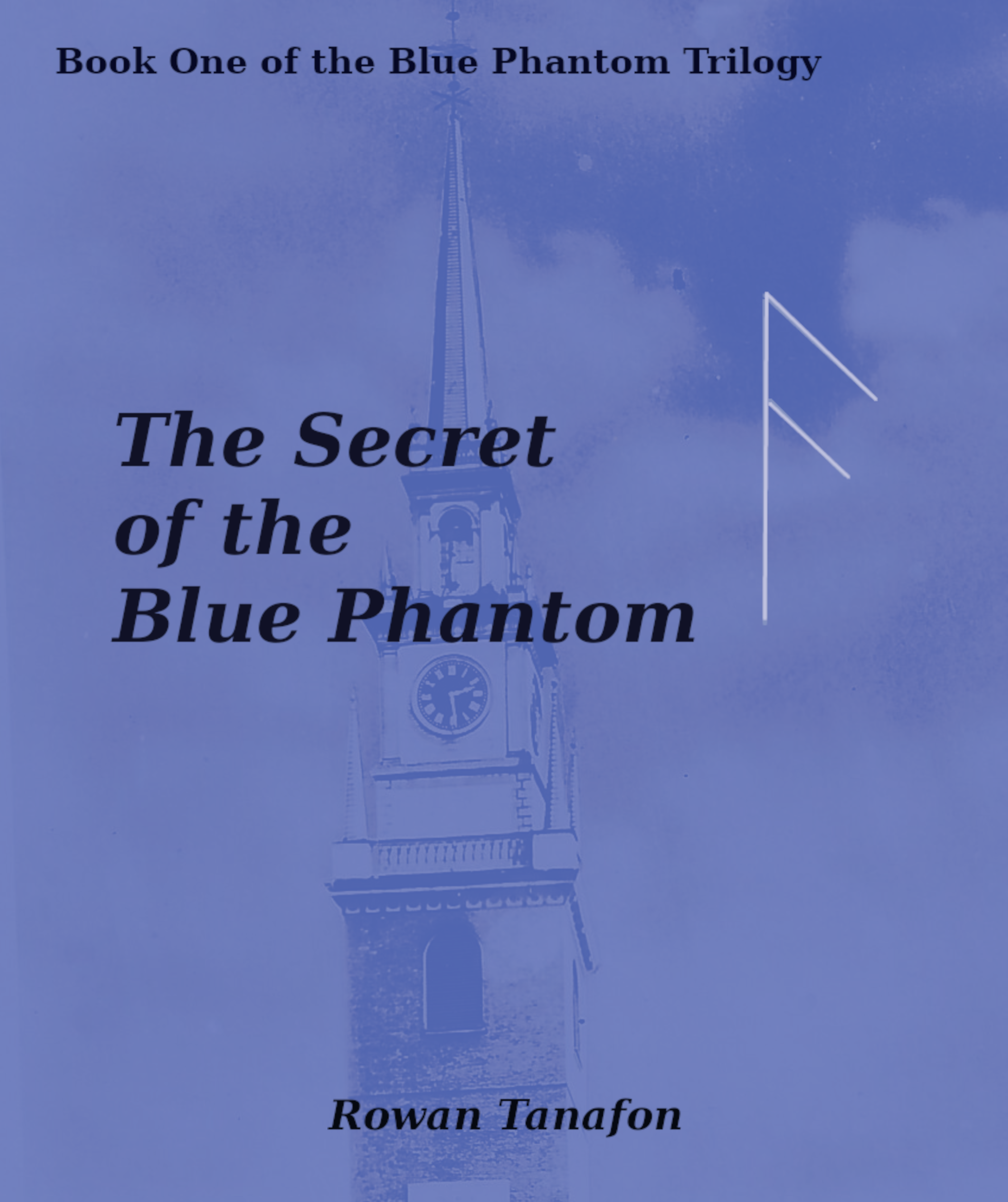
This cover reveal is for my daughter Rowan’s debut novel, The Secret of the Blue Phantom, the first in a series. She’s chosen 1950s Boston as the backdrop for her supernatural detective story, and I think she’s done a terrific job.

Here’s the back cover summary:

“They always see it coming,” McNeil said hoarsely. “He comes to the haunts of the guilty and confronts them with their crime. Then he deals out his ghostly justice…” he pointed to the sign of the Blue Phantom on the wall.

When his parents are murdered, Billy Holster feels like his life is over. But when his detective uncle adopts him, a whole new life begins: full of mysteries, murder, mansions, things that go bump in the night, and a mysterious vigilante known only as the Blue Phantom.
Billy tries to find rational explanations, but is drawn more and more into the realm of the supernatural as his questions multiply. Can ghosts be real? Why does the Phantom leave a Viking rune as his calling card? Is there any connection with the cold murder case that a famous detective has just re-opened? Why does it seem that everyone Billy meets has something to hide?

And most importantly, who is the Blue Phantom, and why won’t he leave Billy alone?

Everything Must Go

I have a problem with the Kindle editions of all my books. The bits and bytes are getting a bit stale. The storage needs to be flushed out and re-optimized. So, everything is on sale next week, including Black Weekend. These are countdown sales, so the earlier you buy, the better!

On sale starting November 20th:

And yes, the second installment of Sean’s Saga, The Well of Time, is on its way and will be up for publication before the end of the year.

Cover Reveal (Front and Back)

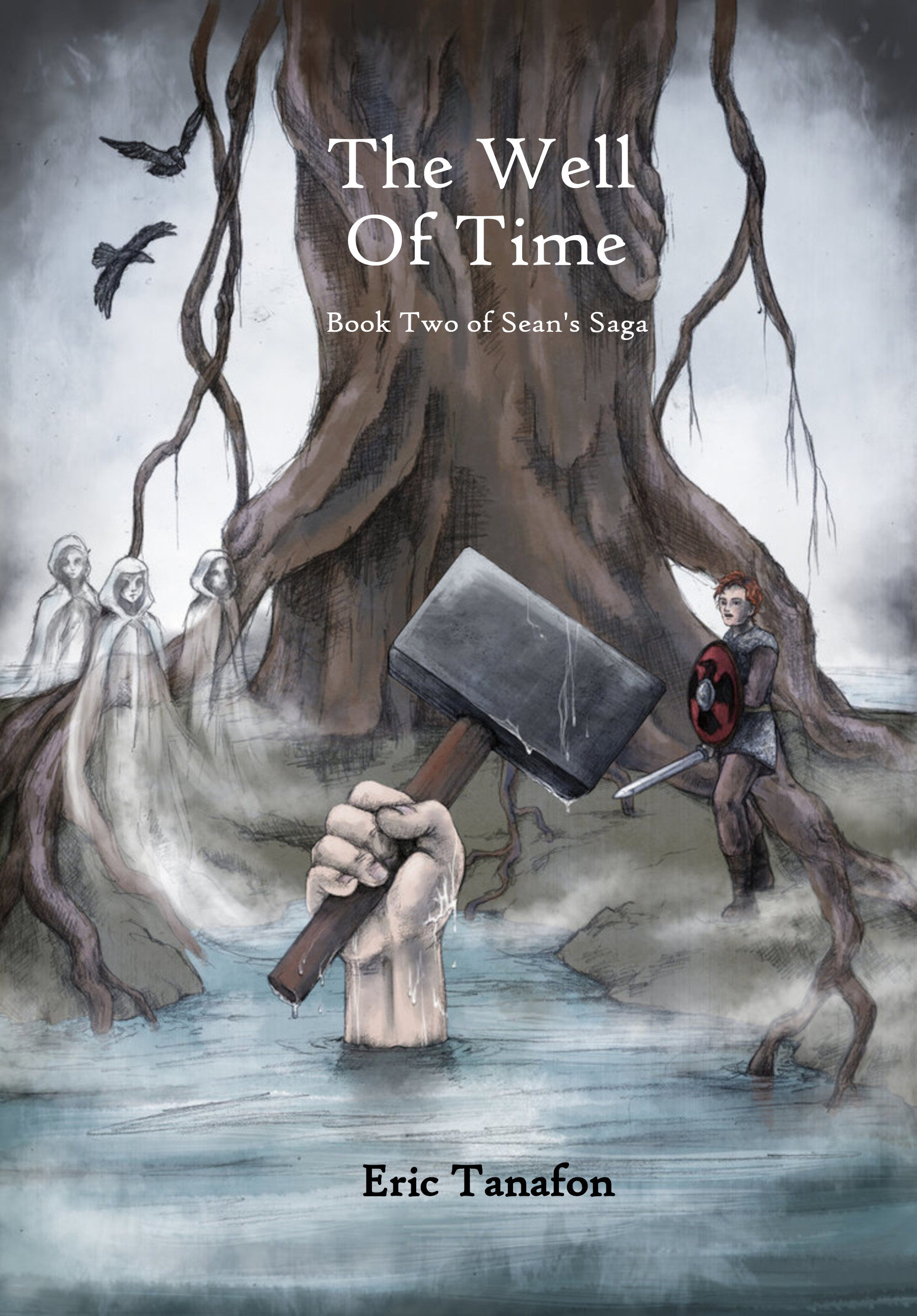
The second book in my Sean’s Saga series, The Well of Time, is quivering on the edge of being ready for publication. Here’s the cover, and Sean’s own back-cover take on this soon-to-be blockbuster fall hit.

Hey, it’s Sean again. It’s time for midterms at Runnymede, and since that includes a Bardic contest where the prize is a taste of the gods’ magic mead, it’s a pretty good bet that the school year will be even busier than summer vacation. Especially when a traitor Bard is helping the enemies of the gods rewrite history, so Ragnarok will be over before it even begins. When you need a bunch of heroes and Valkryies to take on a hopeless quest where you need to think up cool names for all the alternate timelines just so you can keep them straight, who are the gods going to call? Spoiler: me, Fiona, Parvati and Arturo. And the first thing on our to-do list is: Rescue Loki.

Living in the Past

These days, especially if one happens to be working on a story involving alternate timelines*, one thinks a lot about history, about wrong turnings. For instance, what would have needed to happen to head off our current, nearly full-blown, dystopia? I don’t know, and the fact that it all seems so unreal doesn’t help. We all live in a fictional world now. Bad fiction, true—a world of weaponized fear and poisons both physical and spiritual—but still, fiction. What strange turn will the plotline take next? What will we be told when we’re locked down and decimated anew? Will it be nuclear war, an invasion by space aliens, or just the time-honored trope that humanity is the cause of all the earth’s problems, and therefore we have no right to even exist?

People can and do respond with fictions of their own. Many seem to believe that ‘everything is fine and we’ll eventually get back to normal.’ That sounds like a tall tale to me. I would prefer to tell a story that recognizes the evil forces at work in our world and gives people heart to fight them. In the actual fiction I’m writing right now, though, I’m (so far) simply not admitting that recent history actually happened. At the very least, I’m not going to have my characters wear masks and hole up in their homes. If even our fiction admits these insanities, we will be completely lost. So at the moment, that makes my writing firmly metaphysical—even my “base” reality in Sean’s latest adventure, The Well of Time, is already itself an alternate world, one where the Black Death Lite© was never a thing. And I think I’m far from alone in this. 

Another small rebellion I’ve been indulging in is to read some old classic stories. C.S. Lewis says somewhere that if you have limited reading time, you should concentrate on reading books that were written in a different age, as a counterbalance to the influence of the prevailing zeitgeist. And what are the hallmarks of our zeitgeist? Contempt, even hatred, for the human and rosy visions of the “transhuman”**. And not so incidentally, a hatred of history, of things past. Old statues, old religions, old buildings—they just have to go. Otherwise, people might be able to compare the past to the dystopic present, and maybe even figure out the wrong turnings that got us here. 

And that, of course, would threaten the wonderful Cultural Revolution that’s just getting into full swing now. So now we have two excellent reasons for reading old books.

Recently I read three books from the past, and I offer some short takes here. Everyone knows the first two, and (almost) nobody knows the third. They are: Robinson Crusoe, written in the seventeenth century; Moby Dick, from the mid nineteenth century; and Collector’s Luck, written here in New Hampshire in the early twentieth century and appropriately enough, found in a local antique shop.

We’ll take them in order of age. Robinson Crusoe, it turns out, is really a cautionary tale. Early on in the story, Crusoe’s father sits him down for a serious talk about his son’s desire to go to sea, see the world, and make his fortune. The father points out that his fortune is already made—his family is upper middle class, so not wealthy and powerful enough to be consumed with duties and politics, but able to choose whatever career he wants, live well, and be respected in the community.

If you were to just read this part of the story, reflect for a moment on how sensible that advice is, then close the book and read no more—you’ll be doing a lot better than Robinson Crusoe did.

Of course, he does go to sea, and to no reader’s surprise at this point, is shipwrecked. What follows is his famous extended staycation on the desert island he manages to reach, alone at first and later with the original Man Friday. This is the only part of the story most people remember, but really it’s only about half the book. 

In the other half he proves that he didn’t learn much from his experiences. The colony he helps establish on his famous island, made up of convicts and reformed cannibals, eventually collapses. Crusoe himself goes on more voyages, gets Friday killed, and winds up getting shipwrecked again and having to cross Russia to get back to Europe, which sounds like one of those classic mistakes military historians would tell you not to make. There, he comes across a town that holds to the old Pagan ways, and being a “good Christian” he decides to sneak in to their temple under cover of night and vandalize the awful “idol” that these woefully ignorant people worship. 

Hmm, seems like we’ve run into that hatred of the past thing here again. Maybe all the Cultural Revolutions started when monotheism came in. If I get a chance, I’ll interview the former librarians of Alexandria and see what they think.

On the other hand, I’m glad I finally read Moby Dick. This really could be, in fact, the great American novel, which may or may not come as a relief to those who are still trying to write it. 

What makes it so great? Okay, I can list a few things. The fascinating historical details about life on a whaling ship. The sweep and intensity of the central theme, as obsessive as Ahab’s own quest, and the sense of brooding Destiny at work. As far as religion goes, no wimpy New Testament stuff here—instead we have the God who taunted Job with his Leviathan-taming prowess, and prophets popping up to foretell certain doom, just like in the good old days. In fact, Moby Dick could work just as well as a completely Heathen story, with the white whale waiting for Ahab at story’s end, inescapable as Beowulf’s cursed hoard and its guardian dragon.

The style mixes first person narratives from several characters (with stream-of-consciousness touches), mini-essays, and even one chapter written as a play, complete with stage directions. I don’t read criticism these days, but I can’t be the only one who thinks that James Joyce probably picked up a few of his own tricks from reading Moby Dick.

In effect, Melville creates an entire world from the bodies and skeletons of the great whales, like the gods making Midgard, the oceans and the skies, from the body of the primordial giant Ymir. 

I’m not tempted to re-read Robinson Crusoe, but I will most likely visit that world of Melville’s again.

The last book, Collector’s Luck, is, for a change, not a work of fiction. It’s the memoirs of a lady who lived in western New Hampshire in the first decades of the young twentieth century. She talks about her love for history and especially her search for collectable antiques, which take her from Boston to the wilds of New Hampshire, which she visited in a horse-drawn carriage, apparently still the best way to navigate those hills and mountains in the nineteen teens. 

Time has made her story even more charming, even cute—will you look at that, an antique lady searching for antiques! But she knew something many people have forgotten today: the legacy left us by previous generations is a precious thing. Their crafts, their stories, deserve to be honored. 

Or maybe even revived. Her book closes with a description of an old New Hampshire farm house where the settlers had built a well in the middle of the kitchen. A brilliant idea, poetic and practical at the same time, whether the main aim was to protect against attack or enable the family to avoid going outside in winter to pump their water.

An idea whose time may soon come again.

* The Weil of Time, the next installment in Sean’s Saga. Cover reveal is coming when I’ve finished the first version.

** Where’s Nietschze when you need him? “Uberman” was a lot cooler, and really not a bit more Naziesque.